Monday, 29 June 2009


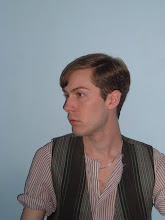
A (very slightly) idealised drawing of Jim.

Sunday, 14 June 2009


Well avid readers of this blog, I can only apologise, I have failed to keep you abreast of the latest developments in McCauley-Bowsteadian thinking; this post is long overdue.

I’ve been undertaking research on portfolios in various areas of art and design and, hopefully, formulating some conclusions on what makes a successful folio. Having the chance to look through and discuss the work of some very exciting up-and-coming practitioners has been genuinely inspiring. It is difficult to communicate the tactile, textural and dynamic qualities of cloth in photographs but you should check out the website of this fantastic textile print designer. www.craftcentral.org.uk/catherine-louise-aitken I find it interesting to see the way that she deals with the tension between the hand drawn and the geometric, as well as playing with our expectations around repeats and regularity. Her drawings are beautiful too.

Another creative I have enjoyed talking to, is Ralph Dorey www.ralphdorey.co.uk
I responded, in particular, to his interest in “Modernism and heroic endeavour”. It’s so refreshing to come across an artist willing to make bold (and optimistic) statements without feeling the need to bog the work down in layer upon layer of reference and worse irony.

Having been in contact with such a rich cross-section of creative activity I’ve felt inspired to recommence some creating of my own. A friend and I are discussing some form of collaboration so I hope to keep you posted on the progress of our project.

Monday, 4 May 2009

Sunday, 19 April 2009

A very old project


Design JMB 2002 inspired by Rodchenko

Friday, 10 April 2009

Incorrect Petridis

I’m aware that The Guardian’s Saturday magazine isn’t the place to turn for advanced critical thinking; nevertheless, one contributor in particular, as I glance through the supplement, never fails to get my goat. – What frustrates me about Alexis Petridis’s weekly column in The Guardian Weekend Alexis Petridis on fashion, isn’t so much that he takes easy shots at men’s fashion, but that in doing so he reveals assumptions which are manifestly heterosexist, gender-normative and conventional.

Petridis’s critique of currently fashionable short-shorts (the sort worn by a male athletes in the 1970s) is indicative of the intellectual laziness of his articles. Any garment which reveals the male figure, and in particular, any garment which is highly fitted or exposes flesh is instantly targeted by Petridis. On the one hand it’s easy to see why leggings or cowl necks might be difficult to pull off and might seem potentially silly in menswear. But the subtext to these critiques, it strikes me, is that while the expression of sexuality and of the physicality of the body in women’s fashion is proper and authentic, in men’s attire it is inappropriate.

For me, fashion, as well as having the potential for formal and aesthetic innovation, is about constructing identities and communicating ideas about oneself. While the narrow and proscribed nature of menswear may appear to be relatively minor issue in the wider battle for gender equality, it is indicative of the way in which men’s gender continues to be policed. In this way, the suppression of authentic, self-expressive modes of male dress is symptomatic of attempts to maintain and enforce a limited, conformist and increasingly irrelevant model of masculinity.

http://www.guardian.co.uk/lifeandstyle/2009/apr/04/alexis-petridis-fashion

Monday, 16 March 2009

Teaching Fashion


As you may know I have recently started teaching on an Access to Art and Design HE course. What's so exciting and ineresting about teaching is the way that it encourages you to consider your subject from an objective standpoint; it isn't until you have to explain some of the skills of a designer, that you are forced to develop a "formalised" understanding of what they are. For example, many of the conventions of fashion drawing exist for quite understandable reasons, to quote some material that I prepared for the class...

Fashion designers often adopt a stylised, “graphic” approach to drawing using clean lines, and tracing figures from previous drawings. This is because designers need to be able to record and work through their ideas efficiently and to communicate these ideas clearly. It is important to understand that fashion drawings needn’t be illusionistic, academic drawings, but they do need to explain the detail and construction of garments, show an understanding of the human figure and evoke the mood of the collection being designed.